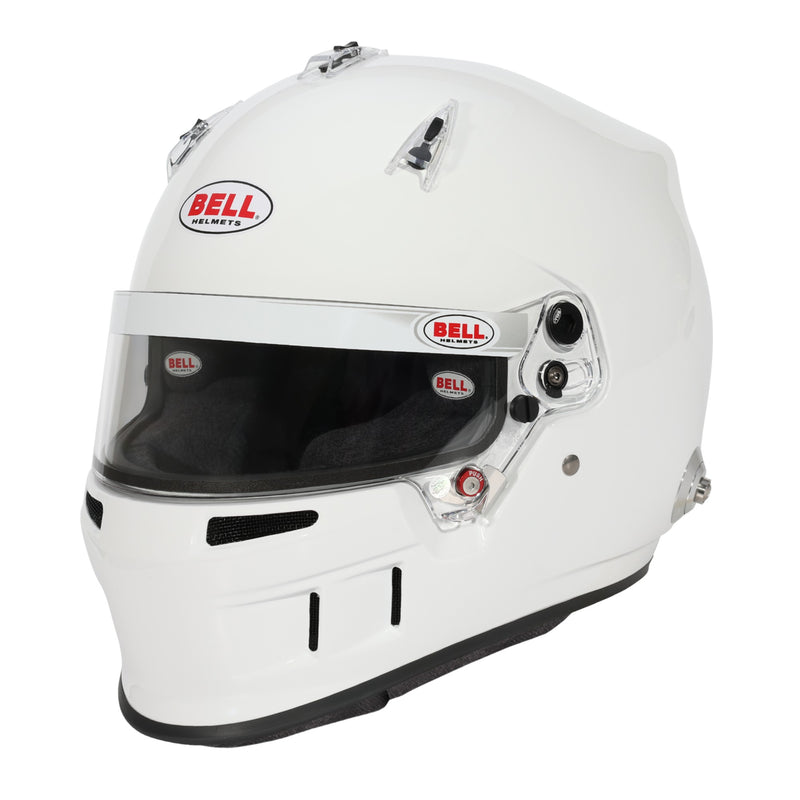
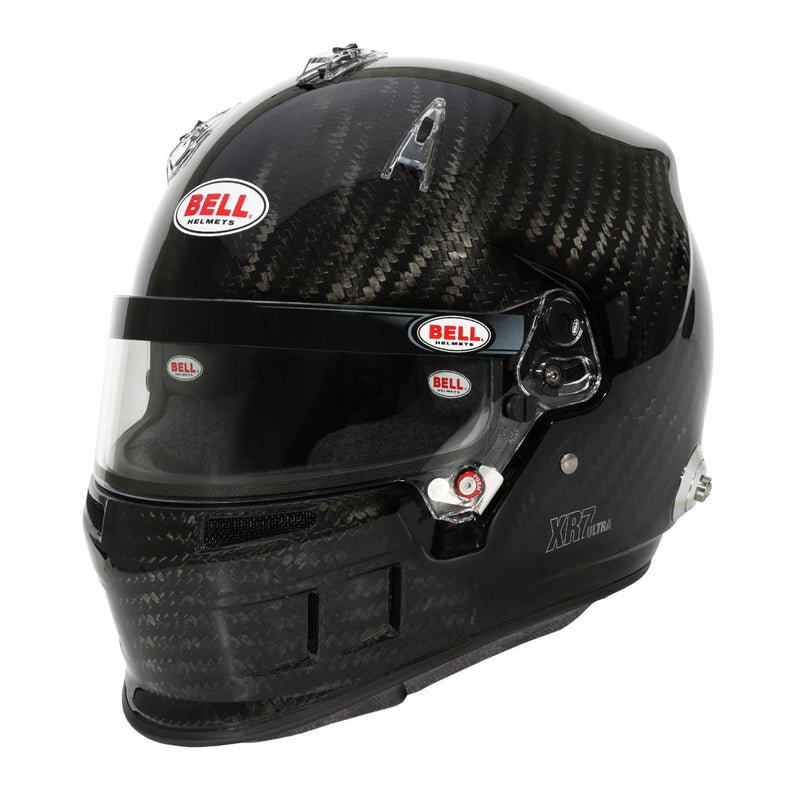
Shopping for a Bell XR7 helmet? The main difference between the Bell XR7 PRO and Bell XR7 ULTRA Carbon is certification and shell material. The XR7 PRO is Snell SA2025-certified with a composite shell, built for series that only require Snell compliance. The XR7 ULTRA Carbon adds FIA 8859-2024 dual certification and a carbon composite shell, needed for FIA-homologated racing. Choose the XR7 PRO if your series only requires Snell. Choose the XR7 ULTRA Carbon if it requires FIA certification.
Racing dirt instead of asphalt? See our Bell XD7 PRO vs. ULTRA Carbon comparison — XR7 is built for asphalt and circuit racing; XD7 for dirt track.
Bell XR7 PRO vs. Bell XR7 ULTRA Carbon
Choose for value
Bell XR7 PRO
Best for series that only require Snell SA2025 compliance.
-
✓ Certification: Snell SA2025
-
✓ Shell: Composite shell
-
✓ Verified weight: 3 lb 6 oz to 3 lb 9 oz (1,524 to 1,608 g), depending on size
-
✓ Size range: 6 sizes, 57, 58, 59, 60, 61, and 61+
-
✓ Color options: White or Matte Black
-
✓ Price position: More affordable option
Choose for premium performance
Bell XR7 ULTRA Carbon
Best for FIA-required competition or racers who want a carbon shell and wider size selection.
-
✓ Certification: Snell SA2025 + FIA 8859-2024
-
✓ Shell: Premium carbon composite shell
-
✓ Weight: Not directly comparable with the PRO
-
✓ Size range: 8 sizes, 57-, 57, 58, 59, 59+, 60, 61, and 61+
-
✓ Color option: Black only
-
✓ Price position: Premium-priced model
What Both Helmets Share
Most of the core helmet platform is identical between the XR7 PRO and XR7 ULTRA Carbon:
-
✓ Ventilation: Lower front chin bar ventilation and three adjustable upper air-intake vents
-
✓ Aero package: Integrated front chin bar gurney, also known as a duckbill, and rear aero design
-
✓ Impact liner: Multi-piece, high-impact-absorbing liner for low- and high-velocity performance
-
✓ Interior: Comfort-Max FR fabric, multiple foam densities, and contoured cheek pads
-
✓ Integrated channels: Built-in face-piece channels for a drink tube or radio microphone system
-
✓ Visor system: SmartLock™ visor with an SE07 3mm DSAF double-screen anti-fog shield
-
✓ HANS/FHR anchors: Factory-installed as standard, with nothing to add or drill
-
✓ Certification floor: Both meet Snell SA2025, while the ULTRA Carbon adds FIA 8859-2024
-
✓ Core sizing: Both include sizes 57, 58, 59, 60, 61, and 61+
-
✓ Box contents: Pre-installed shield, tearoff posts, HANS anchors, hex wrench, drawstring helmet bag, and user manual
-
✓ Store policies: Free shipping on orders over $50, $5 flat-rate shipping under $50, and 30-day returns or exchanges
-
✓ Warranty: Manufacturer warranty facilitated by FAST RACER, with the same claims process for both helmets
Final verdict: Choose the Bell XR7 PRO for value and competition that only requires Snell SA2025. Choose the Bell XR7 ULTRA Carbon when FIA 8859-2024 homologation is required, or when you prefer carbon construction and a wider range of size increments.
Key Differences
1. Certification: Snell-only vs. dual-certified
This decides which helmet you're actually allowed to race in. The XR7 PRO carries Snell SA2025 only. The XR7 ULTRA Carbon carries both — Snell SA2025 + FIA 8859-2024 — the international homologation standard many formula, open-wheel, and international karting series require alongside or instead of Snell. If your sanctioning body's rulebook lists FIA 8859 as a requirement, the PRO isn't eligible — price or color preference doesn't change that. Racers under Snell-based US club or regional rules don't need to pay for FIA certification they'll never use.
2. Shell material: composite vs. carbon composite
The XR7 PRO uses a composite shell. The XR7 ULTRA Carbon uses a premium carbon composite (carbon fiber) shell, built with a high-pressure molding process. Carbon construction is generally marketed for its strength-to-weight ratio, and it's the material tied to the ULTRA's higher price and FIA rating. FastRacer hasn't published independent stiffness or impact data comparing the two shells beyond what each meets for certification — treat "carbon is better" as a material fact, not a verified performance claim.
3. Sizing: 6 standard sizes vs. 8 sizes with half-size fits
The XR7 PRO comes in six sizes, 57 through 61+. The XR7 ULTRA Carbon comes in eight, adding a 57- (7 1/8 Minus) and a 59+ (7 3/8 Plus) that the PRO doesn't offer. If your head size falls between the PRO's standard increments, the ULTRA Carbon's half-size options may deliver a noticeably better fit — and a correctly fitted helmet matters for both comfort and safety performance.
4. Color options
The XR7 PRO is available in White or Matte Black. The XR7 ULTRA Carbon is currently offered in Black only. Buyers who want a specific look, or who are color-matching a team livery, should confirm current color availability on the live product page before choosing based on this factor alone, since color offerings can change.
5. Price position
The XR7 PRO is FastRacer's more affordable option in this lineup. The XR7 ULTRA Carbon is the premium-priced model. The price gap tracks directly to certification and shell material, not to differences in visor, ventilation, or HANS compatibility — those three are identical between the helmets.
Pros and Cons
Bell XR7 PRO
Pros:
- More affordable option in the XR7 line
- Available in two colors (White and Matte Black)
- Verified weight in the 3 lb 6 oz–3 lb 9 oz range across sizes
- Same SmartLock™ visor system and SE07 double-screen anti-fog shield as the ULTRA Carbon
- Same integrated gurney and rear aero design as the ULTRA Carbon
- Factory-installed HANS/FHR anchors standard
Cons:
- Not FIA 8859-2024 certified — not eligible for series that require FIA homologation
- Fewer size options, with no half-size fits available
- Uses a composite shell rather than the ULTRA Carbon's carbon composite build
Bell XR7 ULTRA Carbon
Pros:
- Dual-certified to Snell SA2025 and FIA 8859-2024 — eligible for both domestic and FIA-sanctioned events
- Premium carbon composite shell
- Widest size range in the XR7 line, including two half sizes
- Same SmartLock™ visor, ventilation, and factory HANS anchors as the PRO
- Includes a free Bell Fleece V16 helmet bag
Cons:
- Premium-priced model — a meaningful step up from the PRO
- Only one color option (Black)
- Weight isn't published, so buyers can't verify it's actually lighter than the PRO
Which One Should You Choose?
Choose the Bell XR7 PRO if:
- Your racing series only requires Snell SA2025 certification
- You want to keep upfront cost down
- You want a choice between White and Matte Black
- The standard 57–61+ size run fits you well
Choose the Bell XR7 ULTRA Carbon if:
- Your series requires FIA 8859-2024 homologation
- You want the carbon composite shell
- You need one of the half-size fits (57- or 59+)
- You're comfortable with the premium price and a single color option
For most shoppers, the rulebook decides this, not preference. If your series mandates FIA 8859-2024, the ULTRA Carbon's added cost isn't optional — it's the price of eligibility. If your series only requires Snell, the PRO delivers the same visor, ventilation, aero styling, and HANS compatibility for less, and generally doesn't need the ULTRA Carbon's certification or shell.
Pricing and Availability
Prices can change, so check the live pages for current pricing: Bell XR7 PRO and Bell XR7 ULTRA Carbon. The PRO occupies the more affordable position in the lineup; the ULTRA Carbon occupies the premium position.
Frequently Asked Questions
Which is better for FIA-sanctioned racing, the Bell XR7 PRO or the Bell XR7 ULTRA Carbon?
The Bell XR7 ULTRA Carbon is the only one certified to FIA 8859-2024, so it is required if your series mandates FIA homologation. The Bell XR7 PRO is Snell SA2025-only and is not eligible for FIA-required events, regardless of preference or price. See our full breakdown of dual certification and what it covers for more detail.
Why does the Bell XR7 ULTRA Carbon generally cost more than the Bell XR7 PRO?
The price difference tracks to two verified factors: FIA 8859-2024 dual certification and a carbon composite shell, versus the Bell XR7 PRO's Snell-only certification and composite shell. Visor, ventilation, and HANS compatibility are identical between them.
Why does the Bell XR7 ULTRA Carbon offer more size options than the Bell XR7 PRO?
The ULTRA Carbon comes in eight sizes, including two half sizes, 57- and 59+, that the PRO does not offer. Bell does not publish why the sizing runs differ between the two, so treat it as a real fit advantage for in-between head sizes rather than a marketing claim. Check both size charts against your own measurement either way.
What does Snell SA2025 certification actually test for?
Snell SA2025 evaluates a helmet for impact protection, fire resistance, roll-bar impact resistance, visor performance, and HANS/FHR compatibility. Both the Bell XR7 PRO and Bell XR7 ULTRA Carbon meet this standard. The ULTRA Carbon also adds FIA 8859-2024 for series that require international homologation.
Which is safer, the Bell XR7 PRO or the Bell XR7 ULTRA Carbon?
Both meet the same Snell SA2025 standard, so neither is verified as safer. The Bell XR7 ULTRA Carbon adds FIA 8859-2024 on top of that. This is a certification difference, not a proven safety-performance difference. Read more about why FIA and Snell certifications matter for racing gear generally.
How do I check current prices and availability for the Bell XR7 PRO and Bell XR7 ULTRA Carbon?
Visit the Bell XR7 PRO or Bell XR7 ULTRA Carbon product page directly. Select your size and color to see current pricing and stock status, since both can change without notice.
Bottom Line
The Bell XR7 PRO and Bell XR7 ULTRA Carbon share the same visor, ventilation, aero styling, and HANS anchors — the real choice is certification, shell material, and sizing. The PRO is the more affordable, Snell-only option for racers who don't need FIA homologation. The ULTRA Carbon is the premium, dual-certified option for racers whose series requires FIA 8859-2024, or who want the carbon shell and widest size range. Check current pricing, sizes, colors, and stock on the Bell XR7 PRO and Bell XR7 ULTRA Carbon pages, or browse the SA2025 Helmets collection before you buy.

by Emerson Bersaghi
Emerson Bersaghi is Co-Founder, COO, and CGO of Fast Racer, an e-commerce brand scaling motorsport apparel, parts, and performance gear worldwide. A lifelong kart racer, Emerson brings 29 years of executive leadership at Whirlpool Corporation to Fast Racer's growth strategy. He holds an Executive MBA from Purdue's Daniels School of Business, an MBA from FGV EAESP in Brazil, and a B.S. in Mechanical Engineering from UDESC. At Fast Racer, he drives growth strategy, brand positioning, and strategic partnerships behind the company's sustained double-digit YoY expansion.
Connect with