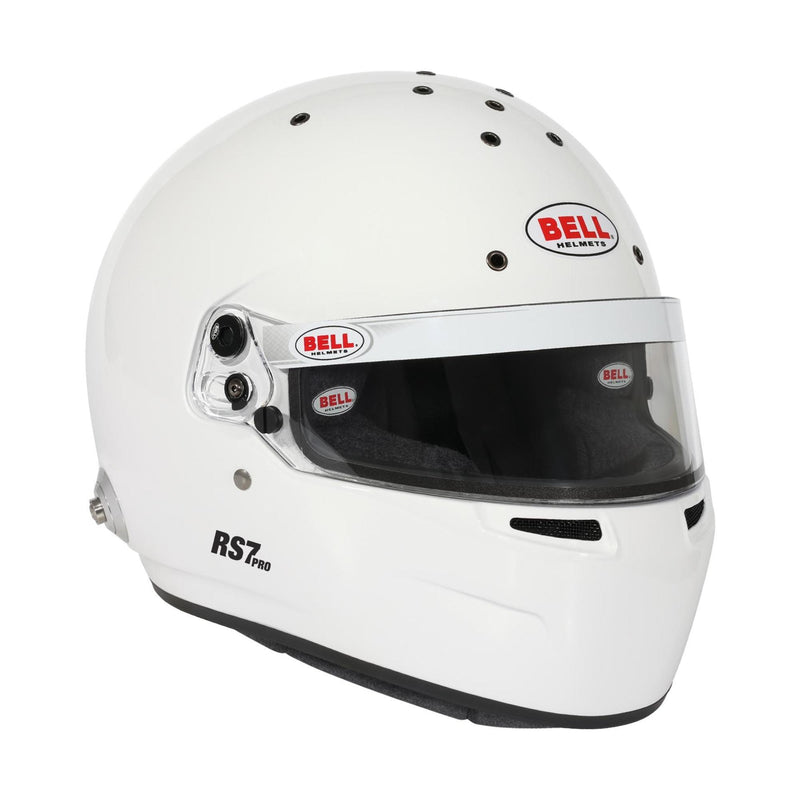
The main difference between the Bell RS7 Pro, RS7 Ultra, and RS7 LITE Ultra is shell material and a small set of equipped features, not the safety platform underneath — all three share the same HP7-derived design, ventilation, visor, and Snell SA2025/FIA 8859-2024 homologation. Choose the RS7 Pro (the most accessible price in the family) if you want the full RS7 feature set for general racing use. Choose the RS7 Ultra (mid-tier pricing) if you race open-wheel or formula cars and want a carbon shell with the air intake kit pre-installed. Choose the RS7 LITE Ultra (the top of the range) if you race closed-cockpit, GT, or NASCAR and want the helmet Bell developed with Penske Racing, at Fast Racer.
Bell RS7 Pro vs Ultra vs LITE Ultra: The 5 Key Differences
What's the actual shell difference, and does it show up on a scale?
The three shells step up in material, not in certification. The Pro uses a lightweight composite shell. The Ultra moves to an ultra-lightweight carbon shell. The LITE Ultra uses an ultra-lightweight aerospace-grade carbon shell. That progression is now verified by weight, not just implied by material name: at size 59, Pro/Ultra/LITE Ultra weigh 1,456g / 1,417g / 1,215g; at size 60, they weigh 1,556g / 1,488g / 1,368g. Ultra is roughly 40–70g lighter than Pro depending on size; LITE Ultra is another 120–200g lighter than Ultra.
Does the certification differ between tiers?
No. All three carry Snell SA2025 and FIA 8859-2024 homologation, so certification is not a reason to choose one over another. This matters because it means the decision comes down entirely to shell material, equipped features, and your discipline's rules — not safety rating. See our guide to dual FIA/Snell certification for what that homologation actually covers.
Do the Pro, Ultra, and LITE Ultra come with different equipped features?
Yes — beyond shell material, the tiers differ in a few equipped features. The Pro's 8/10-hole air intake kit is sold separately, while the Ultra ships with a clear top intake kit already installed; the LITE Ultra is compatible with an optional kit but doesn't include one standard. Ear cups run the opposite way: only the LITE Ultra includes them standard, so Pro and Ultra buyers who want them will need to source them separately. Along with shell material and profile, these equipped-feature differences are what actually separate the three price tiers.
Does profile flexibility matter to you?
The Ultra is the only tier offered in both a standard and a duckbill profile at the same price, giving racers with specific cockpit or visor rules a configuration choice the other two don't offer. The Pro and LITE Ultra are standard-profile only.
Who is each helmet actually built for?
Bell's own product copy frames this by discipline, not just weight: the Pro is positioned for all-around use from open-wheel to closed-cockpit and GT. The Ultra (non-duckbill) is positioned specifically for open-wheel and formula cars. The LITE Ultra was developed with Penske Racing and is positioned for closed-cockpit, GT, and NASCAR use. If your series has a designated discipline, that's a stronger signal than price alone.
Bell RS7 Pro vs. Ultra vs. LITE Ultra
| Attribute |
RS7 Pro |
RS7 Ultra |
RS7 LITE Ultra |
| Price tier |
$: Most accessible |
$$: Mid-tier |
$$$: Top of the range |
| Shell material |
Lightweight composite |
Ultra-lightweight carbon |
Ultra-lightweight aerospace-grade carbon |
| Liner system |
Advanced multi-density liner |
Advanced multi-density liner |
Advanced multi-density liner |
| Ventilation |
14-channel |
14-channel |
14-channel |
| Air intake kit |
8/10-hole kit, sold separately |
Clear top kit, installed |
Compatible with optional kit |
| Ear cups included |
No |
No |
Yes |
| Shell profile options |
Standard only |
Standard or duckbill |
Standard only |
| Homologation |
Snell SA2025 / FIA 8859-2024 |
Snell SA2025 / FIA 8859-2024 |
Snell SA2025 / FIA 8859-2024 |
| HANS anchors |
Factory-installed |
Factory-installed |
Factory-installed |
| Weight (size 59 / 7⅜) |
1,456 g (3 lb 3 oz) |
1,417 g (3 lb 2 oz) |
1,215 g (2 lb 11 oz) |
| Weight (size 60 / 7½) |
1,556 g (3 lb 7 oz) |
1,488 g (3 lb 4 oz) |
1,368 g (3 lb 0 oz) |
| Best for |
All-around use, entry point to the platform |
Open-wheel / formula racing |
Closed-cockpit, GT, NASCAR |
Which Should You Buy?
Choose the RS7 Pro if:
-
You're new to the RS7 platform and want the full feature set at the lowest price
-
Your series doesn't mandate a specific shell material
-
You want the option to add aero accessories (chin bar, gurneys, spoilers) over time rather than buy them bundled
- Budget is your primary constraint and you don't need a duckbill profile
Choose the RS7 Ultra if:
-
You race open-wheel or formula cars, matching Bell's stated use case for this tier
-
Your cockpit or visor setup calls for a duckbill profile
- You want the air intake kit installed rather than purchased and fitted separately
Choose the RS7 LITE Ultra if:
-
You race closed-cockpit, GT, or NASCAR disciplines
-
You want ear cups included rather than sourced separately
- Penske Racing's development involvement matters to you as a trust signal for the top of the range
Consider neither if: you race karts rather than cars — the RS7-K family (PRO and ULTRA kart variants) uses a different homologation standard (Snell K2025 / FIA 8878-2024) and is not interchangeable with the RS7 car-racing line. See the full helmet category page for kart-specific options.
Fast Racer ships all three configurations free via ground shipping on US domestic orders. Specific return-window and warranty terms weren't available at the time of writing — confirm both at checkout or with our team before you buy.
Frequently Asked Questions
Is the RS7 Pro or RS7 Ultra better for open-wheel racing?
The RS7 Ultra is Bell's stated fit for open-wheel and formula racing. The RS7 Pro is positioned as an all-around option that also covers open-wheel, so the Ultra is the more targeted choice if that's your primary discipline.
What is the price difference between the RS7 Pro, RS7 Ultra, and RS7 LITE Ultra?
The Pro is the most accessible price in the family, the Ultra sits at a mid-tier price, and the LITE Ultra is the top of the range. Exact current pricing is on each product page. Check the RS7 Pro, RS7 Ultra, and RS7 LITE Ultra pages directly.
Do the RS7 Pro, Ultra, and LITE Ultra have the same warranty?
This wasn't confirmed in either product's published copy at the time of writing. Confirm warranty terms with FAST RACER before purchase rather than assuming parity across tiers.
Which Bell RS7 is lightest?
The RS7 LITE Ultra is lightest at every matched size checked: 1,215g at size 59 and 1,368g at size 60, versus the Ultra's 1,417g and 1,488g and the Pro's 1,456g and 1,556g at those same sizes. The full progression (composite, then carbon, then aerospace-grade carbon) tracks with weight as expected, though the size-to-size gaps aren't perfectly linear.
Does the RS7 Ultra vs. RS7 Pro difference affect certification?
No. All three tiers carry the same Snell SA2025 and FIA 8859-2024 homologation. The difference between them is shell material and equipped features, not safety certification.
Is the RS7 LITE Ultra worth the price difference over the RS7 Ultra?
That depends on your discipline. The LITE Ultra adds aerospace-grade shell material, a lighter build, included ear cups, and Penske Racing's NASCAR-focused development for a step up in price. If you race closed-cockpit or NASCAR, that positioning matches your use case; if you race open-wheel, the Ultra's duckbill option may matter more to you than the LITE Ultra's material upgrade.
Can I use the RS7 Ultra's duckbill profile with the RS7 Pro or LITE Ultra?
No. The duckbill profile is only offered as its own configuration of the RS7 Ultra; it isn't available as an add-on to the Pro or LITE Ultra.
Bottom Line
The Bell RS7 Pro, Ultra, and LITE Ultra share one safety platform and differ mainly in shell material, weight, price tier, and a handful of equipped features. The Pro is the accessible, all-around choice at the most approachable price in the family, and the heaviest of the three at matched sizes. The Ultra, at a mid-tier price, trims roughly 40–70g off the Pro and is built for open-wheel and formula racers who want a factory-installed air intake kit and a duckbill option. The LITE Ultra, at the top of the range, is the lightest and the closed-cockpit and NASCAR-focused choice developed with Penske Racing, and the only one that includes ear cups. See current pricing on the RS7 Pro, RS7 Ultra, or RS7 LITE Ultra at Fast Racer.

by Emerson Bersaghi
Emerson Bersaghi is Co-Founder, COO, and CGO of Fast Racer, an e-commerce brand scaling motorsport apparel, parts, and performance gear worldwide. A lifelong kart racer, Emerson brings 29 years of executive leadership at Whirlpool Corporation to Fast Racer's growth strategy. He holds an Executive MBA from Purdue's Daniels School of Business, an MBA from FGV EAESP in Brazil, and a B.S. in Mechanical Engineering from UDESC. At Fast Racer, he drives growth strategy, brand positioning, and strategic partnerships behind the company's sustained double-digit YoY expansion.
Connect with